
OMOGANEYA Technical Academy 〜 OMOGANEYA Technical School 〜
Fundamentals of Electrical Engineering | Chapter 1: Direct Current (DC) Circuits – 1.9 Bridge Circuits
By combining series and parallel connections of resistors, a wide variety of DC circuits can be formed.
Here, we will study the “bridge circuit,” one of the most common of these circuits.
1.9.1 Bridge Circuit
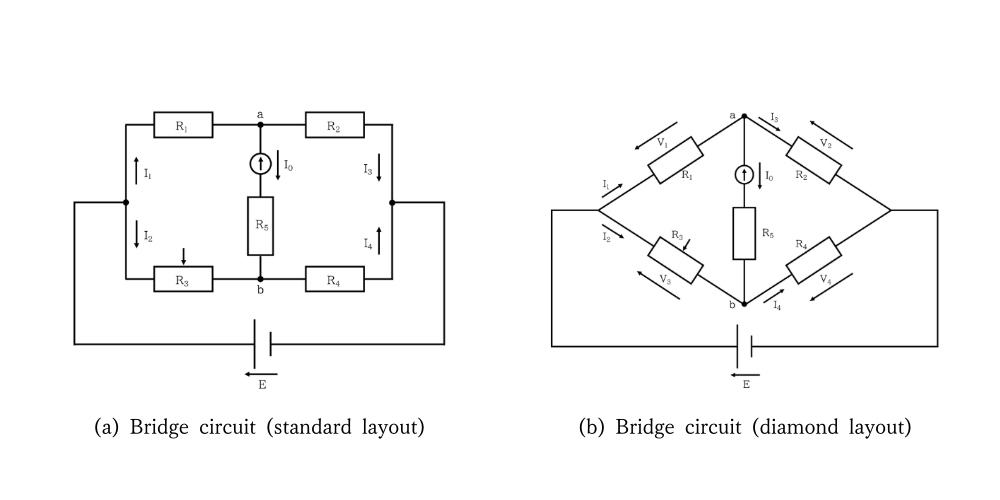
Figure 1.9-1 Bridge circuit
A circuit such as the one shown in Figure 1.9-1 is called a bridge circuit.
If a potential difference exists between points a and b of the circuit, a current flows between a and b.
Conversely, when the potentials at a and b are equal, there is no potential difference, so no current flows.
Now, suppose a galvanometer, which detects very small currents, is connected as shown in Figure 1.9-1, and the variable resistor R3 [Ω] is adjusted until the galvanometer pointer reads zero. The following equations then hold.
Since , the following also holds:
In this state, the bridge circuit is said to be balanced.
1.9.2 Balance Condition of a Bridge Circuit
From Equations (1.9-1) and (1.9-2), the following equation can be derived.
Equation (1.9-3) is called the balance condition of the bridge circuit. When the bridge is balanced, even if the value of one of the four resistors is unknown, it can be determined from Equation (1.9-3).
1.9.3 Wheatstone Bridge
A resistance-measuring instrument that applies the balance condition of the bridge circuit is called a Wheatstone bridge.
The Wheatstone bridge is used for precise measurement of resistances of approximately 10-2 to 10-6 Ω.

Figure 1.9-2 Wheatstone bridge
As shown in Figure 1.9-2, let RX [Ω] be the resistance to be measured, and adjust the variable resistors R1, R2, and R3 [Ω] until the galvanometer pointer reads zero.
When the galvanometer reads zero, the bridge circuit is balanced, so the unknown resistance RX [Ω] can be obtained from Equation (1.9-3) as follows.
About This Article
References
・Denki Kiso (Jo) [Fundamentals of Electricity, Vol. 1], Corona Publishing, by Toshio Utsunomiya, Hiroshi Takahashi, and Isao Izumi
・Denki Kairo Tekisuto [Electric Circuits Textbook], Nippon Riko Shuppankai, by Koichiro Seya
*This article was compiled based on the author’s understanding, with reference to the above literature.

Written by
- Company
- Marine Techno Services, Ltd.
- Business
- ・Import and export of marine machinery and equipment
・Renewable energy-related services
・Procurement and sale of industrial equipment and products - URL
- https://marinetechno.jp/
- Contact
- info@marinetechno.jp
Contact Us
contactFeel free to contact us about listing your products or services, questions on existing listings, or procurement, sales, and trade support through OMOGANEYA.