
OMOGANEYA Technical Academy 〜 OMOGANEYA Technical School 〜
Marine Engineering & Naval Architecture | Ship Design: Basic Design & General Arrangement — 1.1 Classification of Ships
Ships are built in many different types according to the cargo they carry, their intended purpose, and other operational requirements.
In the basic planning stage of ship design, it is essential to organize the shipowner’s requirements, including the intended use and cargo to be transported, and clearly identify the most suitable type of ship.
Ships can be classified in various ways. This section focuses on classification by purpose and explains several representative ship types.
1.1.1 Classification by Purpose
Table 1.1-1 shows the classification of ships by purpose.
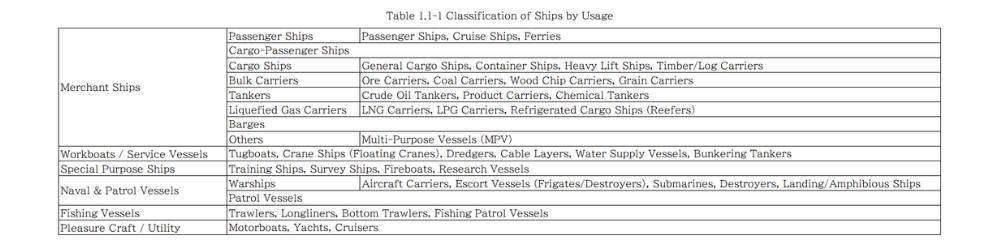
According to their purpose, ships can be broadly classified into merchant ships and other types of vessels.
Merchant ships can be further classified into passenger ships, which transport passengers; cargo ships, which transport cargo; and other merchant vessels.
Container Ships
A ship designed specifically to carry containers is called a container ship (Figure 1.1-1).
The dimensions, construction, and other characteristics of containers are standardized under international standards. Various types are available for different purposes, including dry containers for general cargo, reefer containers for refrigerated and frozen cargo, and tank containers for transporting liquids.
Container ships are widely used for the international transportation of many types of cargo, including daily necessities, electrical and electronic products, and machinery.

Figure 1.1-1 Container Ship
Tankers
A ship equipped with cargo tanks for transporting liquid cargo such as crude oil and petroleum products is called a tanker (Figure 1.1-2).
Tankers include crude oil tankers for transporting crude oil and product tankers for transporting refined petroleum products. Various ship designs are used according to the type and quantity of cargo carried.

Figure 1.1-2 Tanker
LNG Carriers
A ship designed to transport LNG (Liquefied Natural Gas) is called an LNG carrier (Figure 1.1-3).
When natural gas is liquefied, its volume is reduced to approximately 1/600 of its volume in the gaseous state.
Because LNG remains liquid at approximately −162°C under near-atmospheric pressure, LNG carriers are equipped with specialized cargo tanks and cargo-handling systems for storing and transporting LNG at extremely low temperatures.
The principal cargo containment systems used in LNG carriers include the Moss type, which uses independent spherical tanks, and the membrane type, which incorporates insulation and thin metallic membranes within the ship’s hull.

Figure 1.1-3 LNG Carrier with Moss-Type Tanks
Wood Chip Carriers
A ship designed specifically to transport wood chips used as raw material for products such as paper pulp is called a wood chip carrier (Figure 1.1-4).
Wood chip carriers are equipped with deck cranes and cargo-handling hoppers and are characterized by a relatively large freeboard compared with other cargo ships.

Figure 1.1-4 Wood Chip Carrier
About This Article
References
・Ships: From Initial Inquiry to Scrapping, edited by the Editorial Committee of the Kansai Society of Naval Architects
・An Introduction to Naval Architecture in One Volume, edited by the Maritime College Career Education Research Association
・Illustrated Introduction: The Latest Fundamentals and Mechanisms of Ships, 4th Edition, by Toyohiko Kawasaki
※This article was prepared with reference to the sources listed above and organized based on the author’s understanding.

Written by
- Company
- Marine Techno Services, Ltd.
- Business
- ・Import and export of marine machinery and equipment
・Renewable energy-related services
・Procurement and sale of industrial equipment and products - URL
- https://marinetechno.jp/
- Contact
- info@marinetechno.jp
Contact Us
contactFeel free to contact us about listing your products or services, questions on existing listings, or procurement, sales, and trade support through OMOGANEYA.