
OMOGANEYA Technical Academy 〜 OMOGANEYA Technical School 〜
Fundamentals of Naval Architecture | Chapter 1: Calculation of Displacement and Other Hydrostatic Properties 1.3 Calculation of Displacement Volume and Displacement
To determine a ship’s displacement, it is first necessary to calculate the volume of the hull below the waterline.
If the submerged cross-sectional area of the hull is known at each position, the total submerged volume of the hull can be determined by integrating these areas along the length of the ship.
This article explains how to determine displacement volume from cross-sectional areas and how to calculate displacement.
Calculating Displacement Volume from Cross-Sectional Areas
Let the distance measured forward from the aft perpendicular (A.P.) be , the draft be , and the submerged cross-sectional area of the hull at that position be .
If the hull is divided longitudinally into infinitesimal sections of width , the submerged volume of each section is expressed as .
Integrating these volumes from the aft perpendicular (A.P.) to the forward perpendicular (F.P.) gives the displacement volume at draft .
Here, represents the length between perpendiculars, which is the horizontal distance from the aft perpendicular (A.P.) to the forward perpendicular (F.P.).
Here, the submerged portion of the hull is assumed to lie entirely between the aft perpendicular (A.P.) and the forward perpendicular (F.P.).
If any submerged portions extend beyond this range, their volumes must also be included.
Let the transverse distance from the ship’s centerline to the side of the hull on one side be , and let the height measured vertically upward from the baseline be .
For a hull that is symmetrical about its centerline, the displacement volume can also be expressed as follows.
The inner integral determines the submerged cross-sectional area at each longitudinal position, while the outer integral integrates these areas along the length of the ship.
The displacement volume is normally expressed in .
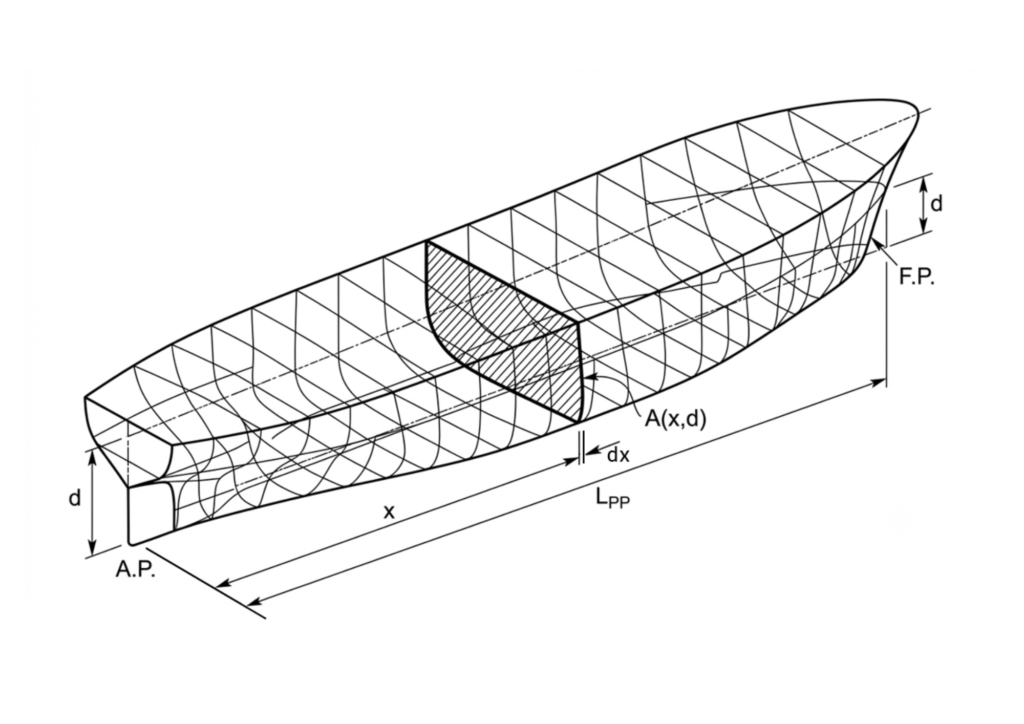
Figure 1.3-1 Method for Calculating Displacement Volume from Cross-Sectional Areas
Relationship Between Displacement Volume and Displacement
When a ship floats on the water, the submerged portion of its hull displaces a volume of water equal to its own volume.
Therefore, the displacement volume is also the volume of water displaced by the ship.
Let the density of seawater be , the gravitational acceleration be , and the specific weight of seawater be . Their relationship is expressed as follows.
If the weight of the displaced seawater is represented by , the following equation applies.
This is the weight of the seawater corresponding to the displacement volume.
According to Archimedes’ principle, the magnitude of the buoyant force acting on the hull is equal to the weight of the seawater displaced by the ship.
Weight of a Floating Ship
When a ship is floating at rest, the upward buoyant force acting on the hull is in equilibrium with the downward weight of the ship .
Since , the following relationship is obtained.
In other words, the weight of a floating ship is equal to the weight of the seawater displaced by the ship.
It is difficult to measure a ship’s weight directly. However, if the shape of the hull is known, the ship’s weight can be determined by calculating its displacement volume from its draft and then calculating the weight of the displaced water.
Units of Displacement
The expression used above represents the magnitude of the gravitational force acting on the displaced water.
If is expressed in , in , and in , the unit of is .
On the other hand, when a ship’s displacement is expressed in , it represents the mass of the displaced water.
In this case, if the density is expressed in , the equation is written as follows.
Thus, even though the same term “displacement” is used, the units must be checked to determine whether it represents weight as a force or mass.
Summary
A ship’s displacement volume is determined by integrating its submerged cross-sectional areas along its length.
When a ship is floating at rest, Archimedes’ principle states that the buoyant force is equal to the weight of the water corresponding to the displacement volume, and this force balances the weight of the ship.
Therefore, determining the displacement volume from the hull form and draft is the starting point for calculating both the ship’s displacement and its weight.
About This Article
Reference
・An Introduction to Naval Architecture in One Volume, edited by the Maritime College Career Education Research Association
※This article was prepared with reference to the source listed above and organized based on the author’s understanding.

Written by
- Company
- Marine Techno Services, Ltd.
- Business
- ・Import and export of marine machinery and equipment
・Renewable energy-related services
・Procurement and sale of industrial equipment and products - URL
- https://marinetechno.jp/
- Contact
- info@marinetechno.jp
Contact Us
contactFeel free to contact us about listing your products or services, questions on existing listings, or procurement, sales, and trade support through OMOGANEYA.