
OMOGANEYA Technical Academy 〜 OMOGANEYA Technical School 〜
Fundamentals of Naval Architecture | Chapter 1: Calculation of Displacement and Other Hydrostatic Properties 1.2 Archimedes’ Principle
When a ship floats on water, its weight acts downward on the hull, while an upward force is exerted by the water.
This upward force is called buoyancy.
After examining how buoyancy arises from hydrostatic pressure, this section explains the conditions required for a ship to float.
Forces Acting on a Cube Submerged in Water
Consider a small cube submerged in water, with each side having a length of .
Let the depth of its upper face be , and the depth of its lower face be .
Also, let the density of the water be , the gravitational acceleration be , and the pressure acting on the water surface be .
The pressure on the upper face and the pressure on the lower face are expressed as follows.
The areas of both the upper and lower faces are .
Hydrostatic pressure produces a downward force on the upper face and an upward force on the lower face. Therefore, the buoyant force , which is the difference between these vertical forces, is given by the following equation.
If the volume of the cube is denoted by , Equation (1.2-2) can be expressed as follows.
Therefore, buoyancy is expressed as the product of the fluid density , the volume of fluid displaced by the body , and the gravitational acceleration .
When the difference between the pressures on the upper and lower faces is taken, the pressure common to both faces and the pressure resulting from the depth cancel out.
In other words, buoyancy is produced not by the pressure acting uniformly throughout the fluid, but by the pressure difference resulting from the difference in depth between the upper and lower faces.
If the water surface is open to the atmosphere, represents atmospheric pressure.
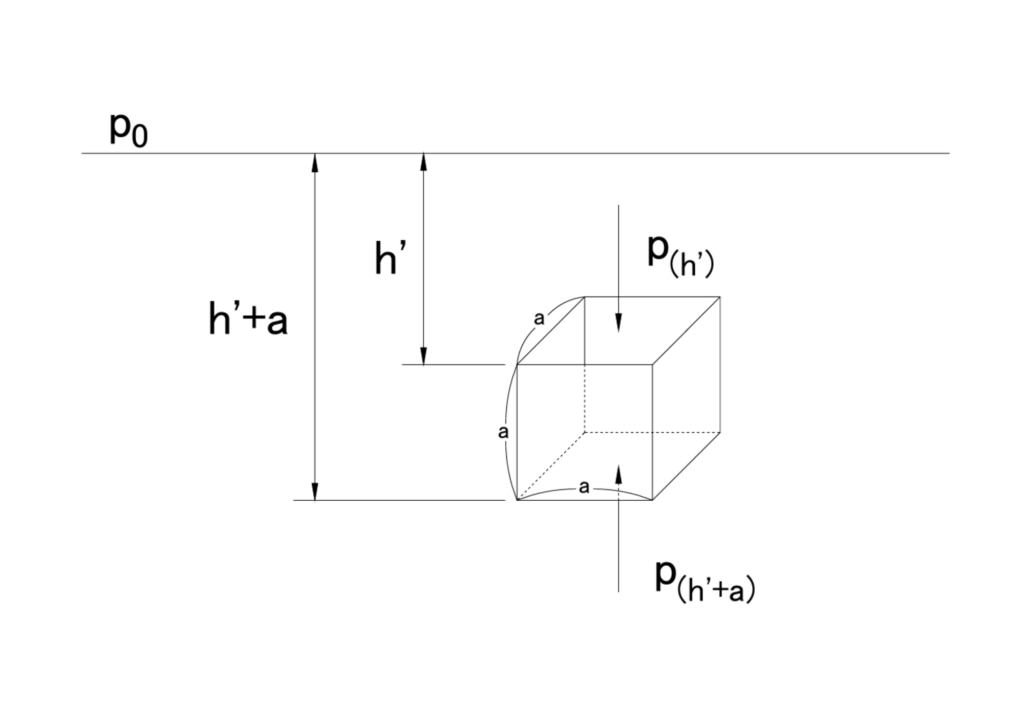
Figure 1.2-1 Forces Acting on a Cube Submerged in Water
Surface Orientation and Pressure in Water
A pressure difference arose between the upper and lower faces of the cube because they were at different depths.
Next, consider the pressure at a single point in water by examining the force equilibrium of an infinitesimal triangular prism.
Consider a sufficiently small triangular prism ABC containing a point in stationary water.
Let the pressures acting on faces AB, AC, and BC be , , and , respectively.
Also, let the depth of the prism be a unit length of , and let the angle between faces AC and AB be .
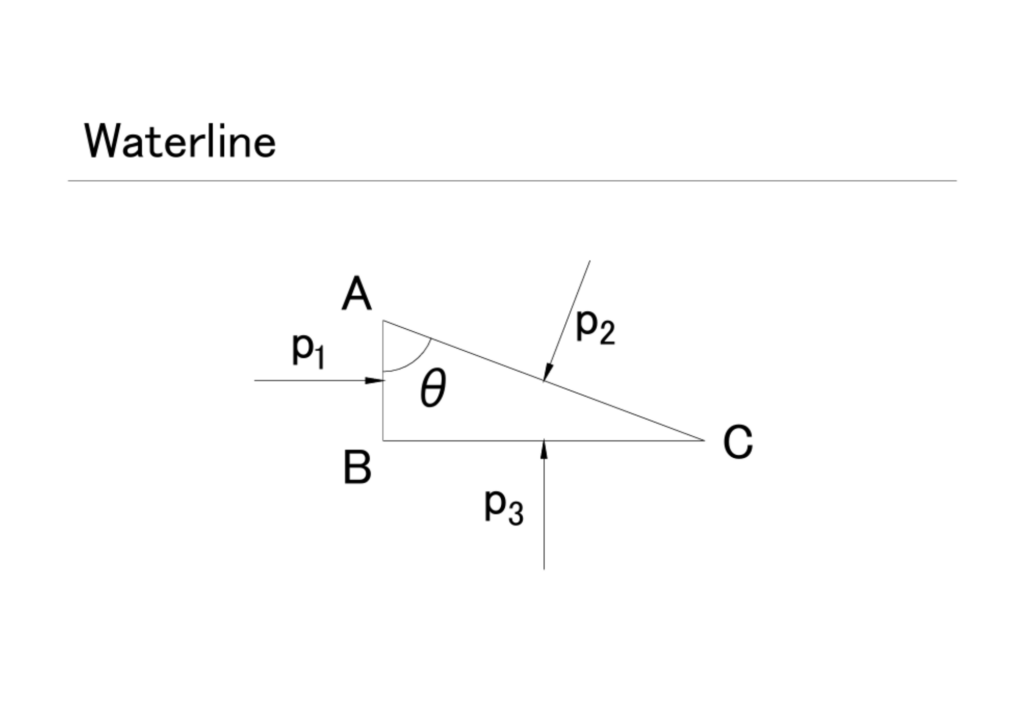
Figure 1.2-2 Surface Orientation and Pressure in Water
First, the forces acting in the horizontal direction are in equilibrium as follows.
The area of face AB is equal to the area of face AC multiplied by .
Therefore, the following relationship is obtained.
Next, consider the forces acting in the vertical direction.
Let the specific weight of water be , and let the lengths of the sides of triangle ABC be , , and , respectively.
The volume of the triangular prism is the area of triangle ABC multiplied by its depth of .
Therefore, the weight of the water inside the triangular prism is .
The equilibrium of the forces in the vertical direction, including the weight of the water, is expressed as follows.
When the triangular prism is made sufficiently small, both AB and BC become infinitesimal, so their product can be regarded as .
Consequently, the term , which represents the weight of the water inside the prism, is sufficiently small compared with the hydrostatic forces acting on its faces and can therefore be neglected.
Thus, the following relationship is obtained.
The area of face BC is equal to the area of face AC multiplied by . Therefore, the following result is obtained.
From the horizontal force equilibrium, , and from the vertical force equilibrium, . Therefore, the following relationship is obtained.
Thus, the magnitude of pressure at the same point in a stationary fluid is independent of the orientation of the surface (isotropy of pressure).
The property by which pressure acts equally in all directions at any point in a fluid is based on Pascal’s principle.
Because of this property, even a complex curved surface such as a ship’s hull can be analyzed by considering the hydrostatic pressure acting perpendicular to each part of the surface.
This does not mean that the pressure is the same at different depths.
A pressure difference occurs between the upper and lower faces of the cube because they are at different depths.
The triangular-prism analysis demonstrates the pressure characteristics when only the orientation of a surface is changed at the same point.
From Infinitesimal Elements to the Entire Submerged Body
For a body of any shape submerged in a fluid, consider dividing it into infinitesimal elements having a width of , a depth of , and a height of .
The areas of the upper and lower faces of each element are , and the difference in depth is .
Therefore, the difference between the hydrostatic forces acting on the upper and lower faces is given by the following equation.
Here, is the volume of an infinitesimal element.
To determine the buoyancy acting on the entire body, the buoyant forces acting on all the infinitesimal elements in the submerged portion of the body are added together.
As the elements are made infinitely small, the summation over the infinitesimal volumes can be expressed as an integral over the differential volume .
Therefore, the buoyant force acting on the entire body is expressed as follows.
is the volume of water displaced by the body.
This equation shows that, for a body of any shape—not only a cube—the magnitude of the buoyant force is equal to the weight of the displaced water.
This is Archimedes’ principle.
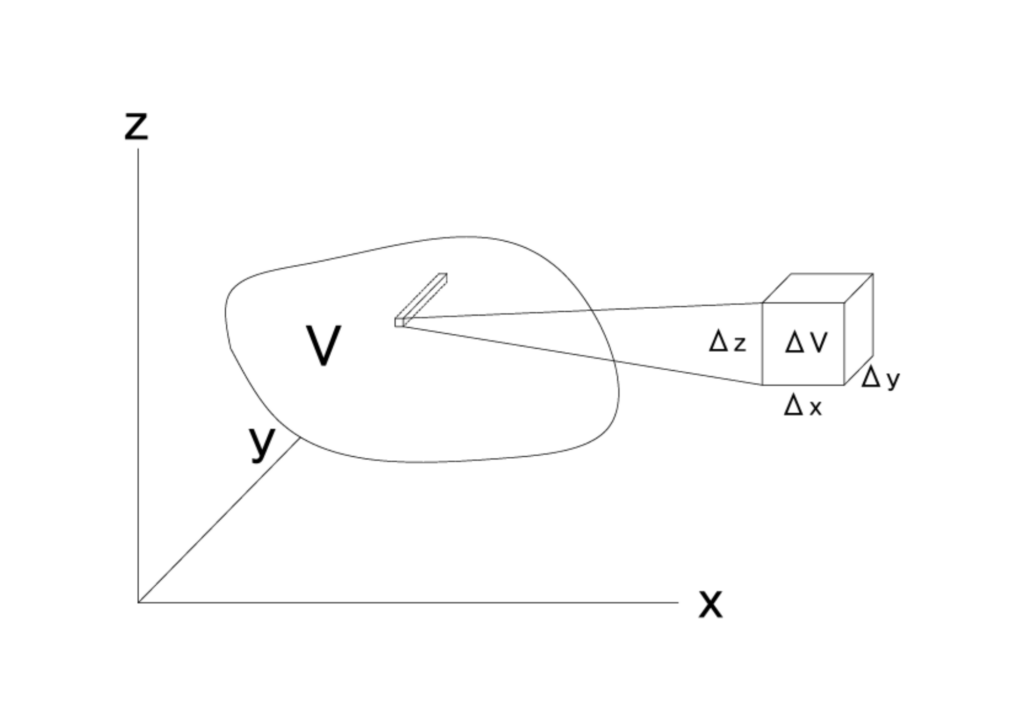
Figure 1.2-3 Dividing a Submerged Body into Infinitesimal Elements
Buoyancy and the Weight of a Body
Let the downward weight acting on a body be , and the upward buoyant force be .
The relationship between these forces determines whether the body rises, remains in equilibrium, or sinks.
When Buoyancy Is Greater Than Weight
A body for which the buoyant force is greater than its weight rises toward the surface.
When part of the body emerges from the water, the submerged volume V decreases, and the buoyant force also decreases.
Eventually, when the weight becomes equal to the buoyant force , the body reaches equilibrium while floating on the water surface.
A floating ship is in this state.
When Weight and Buoyancy Are Equal
When a body is underwater and its weight is equal to the buoyant force , it remains in equilibrium without rising or sinking.
This state is called neutral buoyancy.
Submersibles and submarines adjust their ballast to achieve neutral buoyancy.
A ship floating at rest on the water surface is also in a state in which its weight is equal to the buoyant force .
For a ship, however, this equilibrium is maintained by the buoyancy corresponding to the volume of the submerged portion of the hull.
When Buoyancy Is Less Than Weight
A body whose weight is greater than the buoyant force sinks. However, buoyancy continues to act on the body while it is sinking.
Relationship to Ship Displacement
For a ship floating at rest, the ship’s weight is balanced by the buoyant force .
According to Archimedes’ principle, the buoyant force is equal to the weight of the water displaced by the ship.
The volume of water displaced by a ship is called its displacement volume.
Therefore, determining the volume of the submerged portion of a ship makes it possible to calculate the amount of water displaced by the ship.
In the next section, “1.3 Calculation of Displacement Volume and Displacement,” the sectional areas obtained in Section 1.1 will be used to calculate displacement from the displacement volume.
About This Article
References
・An Introduction to Naval Architecture in One Volume, edited by the Maritime College Career Education Research Association
・Ship Geometry: Fundamentals of Ship Design, by Chan-ik Shin
※This article was prepared with reference to the sources listed above and organized based on the author’s understanding.

Written by
- Company
- Marine Techno Services, Ltd.
- Business
- ・Import and export of marine machinery and equipment
・Renewable energy-related services
・Procurement and sale of industrial equipment and products - URL
- https://marinetechno.jp/
- Contact
- info@marinetechno.jp
Contact Us
contactFeel free to contact us about listing your products or services, questions on existing listings, or procurement, sales, and trade support through OMOGANEYA.