
OMOGANEYA Technical Academy 〜 OMOGANEYA Technical School 〜
Fundamentals of Electrical Engineering | Chapter 1: Direct Current (DC) Circuits 1.1 DC Circuits, Current, Voltage, and Resistance
1.1.1 Direct Current Circuits
The circuit diagram below shows a battery, switch S, and miniature light bulb connected by wires.
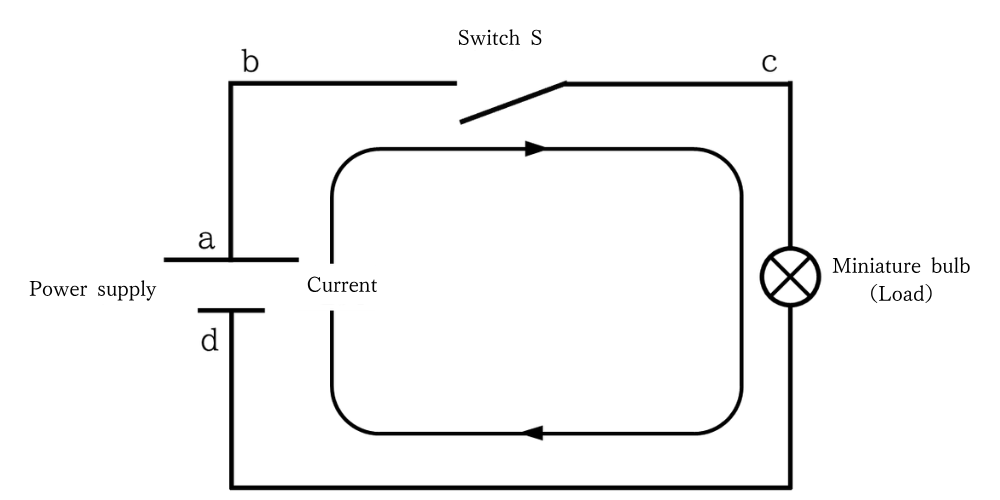
Figure 1.1-1 Circuit Diagram
When the switch is closed, current flows from the positive terminal of the battery through points a, b, and c to the negative terminal d, causing the light bulb to illuminate.
A device such as a battery that supplies electrical energy is called a power source, while a device that receives electrical energy and consumes it is called a load.
This type of path through which electricity flows is called an electric circuit. A circuit powered by a direct current source, such as a battery or solar panel, is called a direct current circuit.
1.1.2 Electric Current
Electric current flowing through an electric circuit is the movement of electrically charged particles, such as electrons.
The quantity of electricity carried by a charged object, such as an electron, is called electric charge. It is represented by the symbol Q and measured in coulombs (unit symbol: C).
Because electric current is the movement of a collection of charged particles through a circuit, its magnitude can be expressed by the amount of charge passing through a cross-section per second.
The magnitude of electric current is represented by the symbol I and measured in amperes (unit symbol: A). When a charge of Q [C] moves during a period of t seconds, the current I is expressed by the following equation.
In other words, 1 [A] is the magnitude of current when 1 [C] of electric charge moves in one second.
【Note】
Electric charge is classified into two types: positive and negative, which are referred to as positive charge and negative charge, respectively.
When equal amounts of positive and negative charge are present, the net charge is zero, and the object is said to be electrically neutral.
Electrons carry a negative charge.
1.1.3 Voltage
The force that causes electric current to flow is called voltage.
Voltage is represented by the quantity symbol V and measured in volts (unit symbol: V).
A power source such as a dry-cell battery can be regarded as the driving force that keeps current flowing. This driving force is called electromotive force.
Electromotive force is represented by the quantity symbol E and, like voltage, is measured in volts [V].
When discussing voltage, the terms electric potential and potential difference are also frequently used.
With respect to a reference point, which is generally the earth at 0 [V], the voltage level of another point relative to that reference point is called electric potential, while the difference in electric potential between two points is called potential difference.
【Note】
Electric potential and potential difference are primarily used in electrostatics. Electric potential refers to the potential energy per unit charge, also known as electrostatic potential.
In electrical engineering, the ground or earth is generally used as the reference point for electric potential, and the potential difference relative to that reference point is called voltage.
1.1.4 Resistance
The degree to which the flow of electric current is opposed is called electrical resistance, or simply resistance.
Resistance is represented by the quantity symbol R and measured in ohms (unit symbol: Ω).
In electric circuits, resistors are used to control electrical resistance.
These components, commonly referred to simply as “resistors,” are used for purposes such as limiting current, dividing voltage, and forming time-constant circuits.
About This Article
Reference
・Fundamentals of Electricity, Volume I, Corona Publishing Co., Ltd., by Toshio Utsunomiya, Hiroshi Takahashi, and Isao Izumi
※This article was prepared with reference to the source listed above and organized based on the author’s understanding.

Written by
- Company
- Marine Techno Services, Ltd.
- Business
- ・Import and export of marine machinery and equipment
・Renewable energy-related services
・Procurement and sale of industrial equipment and products - URL
- https://marinetechno.jp/
- Contact
- info@marinetechno.jp
Contact Us
contactFeel free to contact us about listing your products or services, questions on existing listings, or procurement, sales, and trade support through OMOGANEYA.