
OMOGANEYA Technical Academy 〜 OMOGANEYA Technical School 〜
Fundamentals of Electrical Engineering | Chapter 1: Direct Current (DC) Circuits – 1.13 Conductors, Semiconductors, and Insulators
Materials can be classified into conductors, semiconductors, and insulators according to how easily current flows through them.
Current flows easily through conductors and with difficulty through insulators.
Semiconductors are materials with electrical properties intermediate between those of conductors and insulators.
These differences can be explained not only by the electrical resistivity of a material but also by its energy bands, which represent the energy states of electrons inside the material.
This article explains the basic differences between conductors, semiconductors, and insulators from the perspectives of electrical resistivity and energy bands.
1.13.1 Classification by Electrical Resistivity
How difficult it is for current to flow through a material is expressed by its electrical resistance.
However, electrical resistance varies not only with the type of material but also with the length and cross-sectional area of the conductor.
To compare how difficult it is for current to flow through the materials themselves, electrical resistivity is used.
Electrical resistance is expressed by the following equation using the electrical resistivity , the length of the conductor , and its cross-sectional area .
The smaller the electrical resistivity of a material, the more easily current flows through it; the larger the resistivity, the more difficult it is for current to flow.
In general, conductors such as metals have low electrical resistivity, while insulators have very high electrical resistivity.
The electrical resistivity of semiconductors is higher than that of conductors and lower than that of insulators.
However, the electrical resistivity of semiconductors changes greatly depending on temperature, light, added impurities, crystal condition, and other factors.
1.13.2 What Are Energy Bands?
Electrons in an atom cannot take on just any energy; they exist only in specific energy states.
When many atoms come together to form a solid, the energy states of the electrons in each atom influence one another, and the ranges of energy that electrons can occupy form bands.
These band-shaped ranges of energy that electrons can occupy are called energy bands.
When considering electrical conduction in materials, the following two energy bands are mainly important.
- Valence band: the energy band in which electrons involved in bonding between the atoms of the material mainly exist
- Conduction band: the energy band in which electrons can move through the material and contribute to electrical conduction
Between the valence band and the conduction band, there is an energy region in which electrons cannot exist.
This region is called the band gap or forbidden band.
1.13.3 Band Gap
The size of the band gap is expressed by the energy difference between the top of the valence band and the bottom of the conduction band.
For an electron to move from the valence band to the conduction band, it needs enough energy to cross the band gap.
The smaller the band gap, the more easily electrons can move to the conduction band.
Conversely, the larger the band gap, the more difficult it is for electrons to move to the conduction band.
This difference is related to how easily current flows through conductors, semiconductors, and insulators.
1.13.4 Differences in Energy Bands
Conductors, semiconductors, and insulators differ in the relationship between the valence band, the conduction band, and the band gap.
Energy Bands of Conductors
Conductors are materials through which current flows easily; metals are typical conductors.
In conductors, either the valence band and the conduction band overlap, or there are empty states available for electrons to move into within the energy band they occupy.
Therefore, when an external electric field is applied, electrons can move relatively easily.
In conductors, there is no need to supply a large amount of energy to move electrons from the valence band to the conduction band, and many electrons can contribute to electrical conduction.
Energy Bands of Semiconductors
In semiconductors, there is a relatively small band gap between the valence band and the conduction band.
When no energy is supplied, electrons in the valence band do not move freely.
However, when they receive energy above a certain level from heat, light, or other sources, some electrons cross the band gap and move to the conduction band.
When an external electric field is applied, electrons that have moved to the conduction band move through the material and contribute to electrical conduction.
In addition, when an electron moves from the valence band to the conduction band, it leaves a vacancy behind in the valence band.
This vacancy is called a hole.
In semiconductors, electrons in the conduction band and holes in the valence band act as charge carriers that carry electricity.
Energy Bands of Insulators
In insulators, there is a relatively large band gap between the valence band and the conduction band.
Therefore, at normal temperatures and voltages, electrons in the valence band are unlikely to obtain the energy needed to move to the conduction band.
Because very few electrons can move to the conduction band, almost no current flows through an insulator.
However, even in an insulator, when a very high voltage is applied, electrons may suddenly move and a current may flow.
This phenomenon is called dielectric breakdown.
1.13.5 Differences Between Conductors, Semiconductors, and Insulators
The differences between conductors, semiconductors, and insulators can be summarized as follows.
- Conductors: The valence band and the conduction band overlap, or there are empty states into which electrons can move, so current flows easily.
- Semiconductors: There is a relatively small band gap, and electrons can move to the conduction band with energy from heat, light, or other sources.
- Insulators: There is a relatively large band gap, and under normal conditions it is difficult for electrons to move to the conduction band.
Semiconductors and insulators cannot always be clearly distinguished by the size of the band gap alone.
In general, semiconductors have smaller band gaps than insulators, but the electrical properties of a material are also affected by its band structure, temperature, impurities, crystal condition, and other factors.
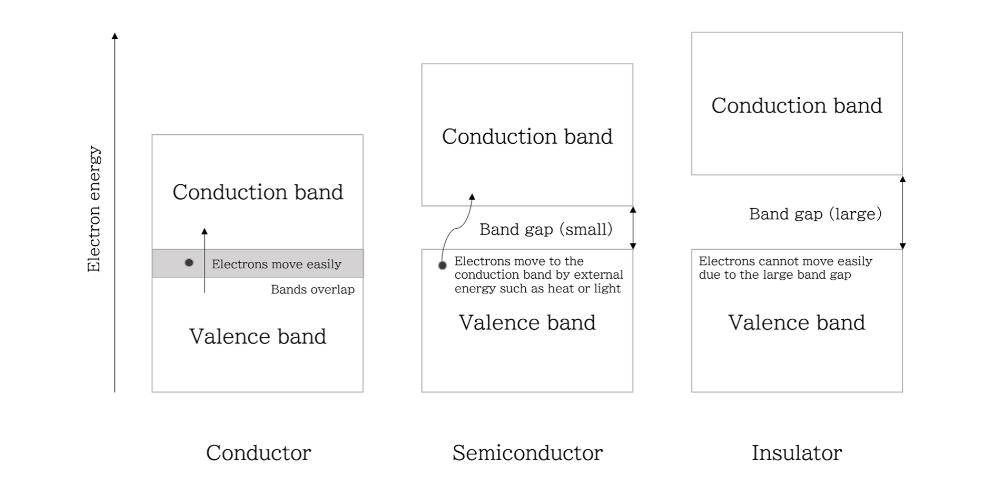
Figure 1.13-1 Differences in the Energy Bands of Conductors, Semiconductors, and Insulators
The figure places conductors, semiconductors, and insulators side by side to show the differences in their valence bands, conduction bands, and band gaps.
Conductors are shown with overlapping valence and conduction bands, semiconductors with a small band gap, and insulators with a large band gap.
1.13.6 Band Gaps of Typical Materials
The band gaps of typical semiconductors and insulators are shown below.
Table 1.13-1 Band Gaps of Typical Materials
| Material | Chemical formula | Band gap |
| Germanium | Ge | 0.67 eV |
| Silicon | Si | 1.11 eV |
| Gallium arsenide | GaAs | 1.43 eV |
| Cadmium sulfide | CdS | 2.42 eV |
| Zinc oxide | ZnO | 3.37 eV |
| Aluminum oxide | Al₂O₃ | 7.0 eV |
| Silicon dioxide | SiO₂ | 9.0 eV |
As a guideline for distinguishing semiconductors from insulators, materials with a band gap smaller than about 3 eV are sometimes classified as semiconductors, and those with a band gap larger than about 3 eV as insulators.
However, this is not an absolute boundary.
For example, zinc oxide has a band gap exceeding 3 eV but is generally treated as a wide-bandgap semiconductor.
Therefore, when classifying conductors, semiconductors, and insulators, it is necessary to consider not only the band gap value but also the actual electrical properties.
1.13.7 Why the Conductivity of Semiconductors Changes
An important feature of semiconductors is that their conductivity changes depending on externally applied conditions.
When the temperature rises, electrons in the valence band receive thermal energy and move more easily to the conduction band.
When light is applied, electrons may also absorb the light energy and move to the conduction band.
Furthermore, adding a small amount of impurities to a pure semiconductor changes the number of electrons or holes, making it possible to adjust its conductivity.
Intentionally adding impurities to a semiconductor is called doping.
Semiconductors made by doping mainly include n-type semiconductors and p-type semiconductors.
By combining n-type and p-type semiconductors, semiconductor devices such as diodes and transistors can be constructed.
1.13.8 Fermi Level
When considering which energy states the electrons inside a material occupy, an energy level called the Fermi level is used as a reference.
The position of the Fermi level relative to the energy bands differs among conductors, semiconductors, and insulators.
In semiconductors, the position of the Fermi level also changes depending on temperature, the type of impurities, carrier concentration, and other factors.
Using the Fermi level, the number of electrons in the conduction band and holes in the valence band can be determined quantitatively.
Summary
Conductors, semiconductors, and insulators exhibit different electrical properties depending on their electrical resistivity and energy band structure.
In conductors, electrons move easily and current flows easily.
Semiconductors have a relatively small band gap, and their conductivity can be changed by heat, light, doping, and other means.
Insulators have a large band gap, and under normal conditions, almost no electrons contribute to electrical conduction.
The controllable conductivity of semiconductors is used in a wide range of electronic and electrical devices, such as diodes, transistors, light-emitting devices, and solar cells.
About This Article
References
- “Review on Charge Carrier Transport in Inorganic and Organic Semiconductors,” Seema Morab, Manickam Minakshi Sundaram, Almantas Pivrikas
(Last accessed: October 5, 2026)
*This article was compiled based on the author’s understanding, with reference to the above literature.

Written by
- Company
- Marine Techno Services, Ltd.
- Business
- ・Import and export of marine machinery and equipment
・Renewable energy-related services
・Procurement and sale of industrial equipment and products - URL
- https://marinetechno.jp/
- Contact
- info@marinetechno.jp
Contact Us
contactFeel free to contact us about listing your products or services, questions on existing listings, or procurement, sales, and trade support through OMOGANEYA.